Rothenburg at Christmas: When to Come to See the Fairytale Town
Market dates, what stays open in December, and the one hour that decides the whole visit.
Buy the Audio Guide The One-Day Plan Quick AnswersIn mid-December the sun goes down over Rothenburg ob der Tauber at 16:20. The Christmas market runs until 19:00, 20:00 on Fridays and Saturdays. Do the arithmetic and you get the thing nobody puts on the postcard: you will see this town in the dark, under strings of light, with your hands around a hot cup. That is not a consolation prize. That is the visit.
So — is Rothenburg ob der Tauber really Germany's fairytale Christmas town, or is that a line invented by tour operators? Both, honestly. The setting is real: a complete medieval wall, gabled houses, a market square that has been the centre of the town since the Middle Ages. The crowds are also real, and for six hours in the middle of the day in Advent the place belongs to coach groups. This guide is about getting the first part without the second.
You can take the town's story with you as you walk: the TouringBee audio guide to Rothenburg works the same in December as in June — 25 stops, offline, in your ears. Walk the route in the afternoon while there is light, then come back to the square when the lights come on. That sequence is the whole trick, and we will come back to it.
Still planning the whole trip? Start with our complete guide to Rothenburg ob der Tauber, then come back here for the Christmas details.
At a glance
- Market 2026
- Reiterlesmarkt, 20 November – 23 December
- Closed
- One day only — Totensonntag, 22 November
- Hours
- Sun–Thu 11:00–19:00 · Fri–Sat 11:00–20:00
- Size
- 61 stalls across four linked squares
- Sunset
- 16:20 in mid-December — the market is an evening event
- Best hour
- 16:00–17:00, while the sky still holds blue
The short answer
Yes, if you come for the evenings. Rothenburg ob der Tauber is at its best in Advent, and the credit belongs less to the market than to the town around it — you are not looking at a market in front of a shopping centre, you are looking at a market inside a walled medieval town that never got modernised.
No, if you come for a mid-day day trip in December and expect a fairytale. Between roughly 11:00 and 16:00 the old town is busy, the light is flat and grey, and the market is at its least magical. It gets its atmosphere back at dusk, which in December means from about half past four.
And no, if you come outside the market dates. More on that below — it is the single most common disappointment, and almost no page warns you about it.
The Reiterlesmarkt: dates, hours and what is actually there
In 2026 the market runs from 20 November to 23 December. It closes for exactly one day, Totensonntag on 22 November — the German day of remembrance for the dead, when Bavaria shuts down public entertainment. Turn up on that Sunday and you will find an empty square and a lot of shuttered wooden huts.
There are 61 stalls, spread across four linked spaces: the Marktplatz in front of the town hall, the Grüner Markt just north of it, the Kirchplatz by St James's Church, and the covered Lichthof inside the town hall itself. You can walk the whole thing in fifteen minutes. By German standards it is a small market, and that is exactly why it feels like a town celebrating rather than a trade fair.
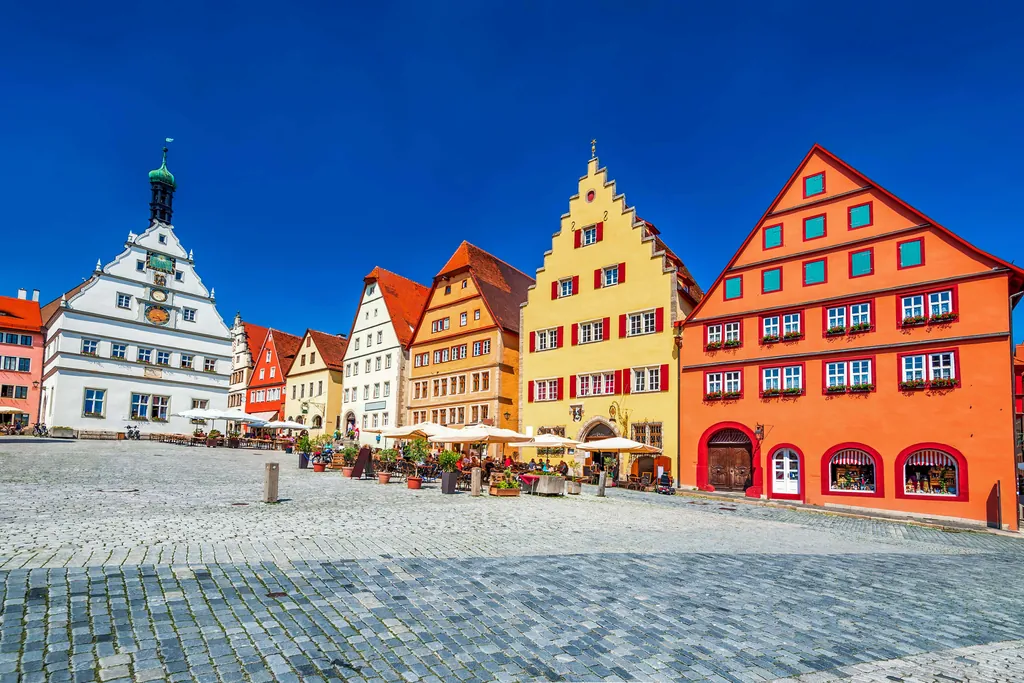
A stage on the Grüner Markt has brass bands from the surrounding Franconian villages playing daily. On the second floor of the town hall, a new Advent window is lit each evening, designed by local school classes and youth groups — a village-scale tradition that survives in a town that has long lived on tourism.
Opening night is worth planning around: a rider comes into the market square on horseback, greets the crowd, the mayor speaks, and the tree is lit.
The Reiterle: the ghost that became a Christmas figure
Most German markets are named after a saint, a square or a product. Rothenburg's is named after a ghost.
The town's own brochure puts it plainly: the Reiterle "has its historical origin in the distant past. To our ancestors it was an envoy from another world, who in wintertime floated through the air with the souls of the dead."
That is the pre-Christian midwinter belief — the dark weeks when the dead were thought to ride the sky. Over the centuries the figure was softened, and today it opens a Christmas market on horseback and waves at children.
Be careful with the dating. The town's tourism service links the market's tradition to the fifteenth century; Deutsche Bahn writes of a history going back "over 500 years." Neither can be pinned to a document, so the honest position is that the start of the tradition is hard to date.
Stand in the square on opening night and you are watching the tamed version of a death omen bless a shopping street.
Käthe Wohlfahrt: the Christmas that never closes
On Herrngasse, a minute from the market square, there is a shop thanks to which people come to Rothenburg for Christmas the other eleven months of the year.
Käthe Wohlfahrt's Weihnachtsdorf — the Christmas Village — is an enormous shop of German Christmas decoration laid out as an indoor village: a rotating lit tree several metres high, wooden houses, Erzgebirge nutcrackers, pyramids, Schwibbögen, glass ornaments, thousands of them. It is open all year, including Sundays, which in Germany is genuinely unusual.
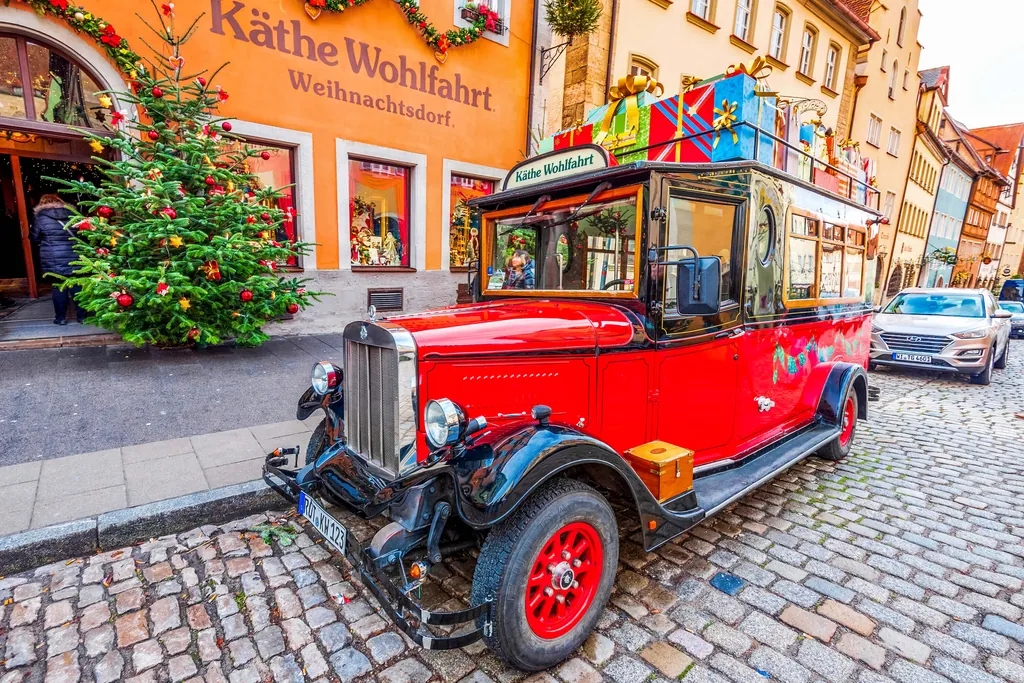
It is a retail environment designed so that leaving without a bag feels like an error. It is also, on a wet Tuesday in March, the only place in town where it is December.
The German Christmas Museum: upstairs from the shop
Inside the same building, reached by a staircase from within the shop, is the Deutsches Weihnachtsmuseum. People routinely confuse the two. The shop sells; the museum explains.
Inside are rare Christmas decorations from the nineteenth and early twentieth centuries: tragacanth and cotton-wool figures, Leonic wire ornaments, early glass baubles, incense smokers, Advent calendars, nativity scenes. A separate section covers the competing gift-bringers of German tradition — St Nicholas, the Christkind, the Weihnachtsmann. If you have ever wondered why the Christ Child brings presents in Bavaria and Santa does it in Hamburg, this is where that gets answered.
Admission is €5.00 for adults, €2.00 for children aged 6 to 11, €4.00 reduced and €11.00 for a family ticket. Advent hours are Monday to Thursday 10:00–17:30, Friday and Saturday 10:00–18:00, Sunday 10:00–17:00; the rest of the year it opens daily 10:00–17:00. Allow 45 minutes to an hour. It is not step-free.
Over Christmas itself it stays open on reduced hours: 24 December 10:00–13:00, 25 and 26 December 10:00–16:30, 31 December 10:00–13:00, 1 January 10:00–16:30.
What to eat and drink
The food here is Franconian, not generic German.
Schneeballen are the town's own thing and you will see them everywhere — fist-sized tangles of shortcrust pastry, deep-fried, classically dusted with icing sugar, now also sold in chocolate and nut versions. The town's tourism service calls the recipe centuries old. Honest advice: buy one small one to share. They are dry by design, and a whole one each is a commitment.
At the stalls, look past the standard Glühwein for the local versions:
- Quittenglühwein — quince mulled wine, sharper and less cloying than the grape version; there is a winemaker's version too, from the Tauber valley
- Feuerzangenbowle — a rum-soaked sugarloaf set alight over the punch bowl; theatre as much as a drink
- Met in a drinking horn — mead, sold exactly as ridiculously as it sounds, and exactly right in a medieval town
- Fränkisches Rotbier — Franconian red beer, a local style with a long cold maturation, if you want something that is not sweet
To eat: half-metre bratwurst, Käsespätzle, Leberkäse, roast chestnuts, gingerbread, Stollen, gebrannte Mandeln. There are vegan soups and vegan bratwurst too — not something you could say about this market ten years ago.
One practical note that saves annoyance: your mug carries a deposit, and there is a dedicated stall for returning it. Keep the mug if you want it — that is allowed, the deposit is the price.
The town after dark — and the one hour that matters
The market is, functionally, an evening event, and it has one working hour. Between about 16:00 and 17:00 the sky still holds blue, the lights are already on, and the windows are lit. That is the shot. After 17:30 the sky goes black and the contrast becomes harsh; before 16:00 the lights are lost in grey daylight.
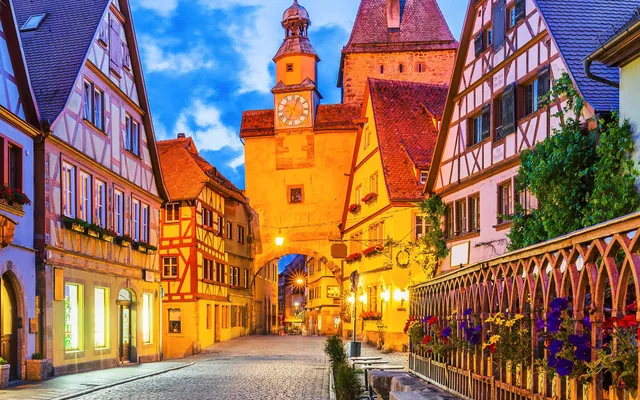
Where to stand:
- Plönlein — the fork of two lanes around the yellow half-timbered house, and the most recognisable view of Rothenburg. In December it is lit. Go before the market opens or after 19:00 if you want it without people.
- Marktplatz — the tree, the town hall façade, the lit Advent window on the second floor.
- The town wall — a stretch of the covered rampart in the dark, with the market noise below and the town lit through the arrow slits. Day visitors almost never get here.
- Herrngasse looking back towards the square, with the shops lit on both sides.
A tripod is allowed and useful — and the wall has ledges that work as one.
What else is open in December
The market is not the whole town, and December hours are shorter than summer ones. Current for the 2026/27 season:
- Town Hall Tower — during the market, daily 10:30–14:00 and 14:30–18:00, to 19:00 Friday to Sunday. €4 adults, €2 under 14, cash only. 220 steps, and the whole lit old town from the top.
- Medieval Crime Museum — 2 November 2026 to 6 January 2027, daily 11:00–16:00, last entry 15:15. Advent Saturdays (28 November, 5, 12 and 19 December) it stays open to 17:00. €10.50 adults.
- St James's Church and Riemenschneider's Holy Blood Altar — €5 adults, €3.50 reduced, free under 12. Somewhere to warm up and look at the carving without rushing.
- The Night Watchman tour runs through Advent, nightly at 21:30, up to and including 23 December. €8 adults.
- The town wall — free, open at all hours, no closing time.
The honest part: Rothenburg outside the market dates
This is the paragraph that should exist on every page about Christmas in Rothenburg ob der Tauber and almost never does.
After 23 December, the market is gone. Not winding down — gone. The huts come down, the square empties. Travellers book the week between Christmas and New Year, expecting the market they saw in photographs, and arrive to a quiet medieval town in the cold. Same trap at the other end: in early November there is no market, no lights, and short museum hours.
The town's permanent Christmas layer — Käthe Wohlfahrt, the Christmas Museum — stays open, and the old town decorations stay up through Advent. But the market has hard dates. 20 November to 23 December 2026. Book inside them.
Day trip or overnight?
Overnight, if the choice is yours. A day trip from Munich, Frankfurt or Nuremberg puts you in Rothenburg roughly between 11:00 and 16:00 and takes you away before the blue hour — that is, before the part worth coming for. The parking tariff says the same thing sideways: coaches pay between 09:00 and 18:00 and park free after.
Stay one night and you get the old town at 22:00 with the lights still on and nobody in it, which is the single best hour Rothenburg has. If a day trip is the only option, invert the standard schedule: arrive late, skip the midday market, walk the town and the wall while it is light, and spend your last two hours in the square after dark.
A one-day Christmas plan that works
13:30 — Arrive. Drop bags. Coffee, not Glühwein yet.
14:00 — The TouringBee route through Rothenburg: the wall, the Plönlein, Herrngasse, the quiet lanes behind the square. Ninety minutes at a comfortable winter pace, and the route ends near the market.
15:30 — The German Christmas Museum, or the Town Hall Tower for the view over the lit town. Pick one; both take about an hour, and the museum is the warmer choice.
16:20 — Sunset. Be outside for it. Plönlein first, then walk up to the square as the sky turns.
17:00 — The market. Eat first, then go for the Glühwein, in that order. Watch the Advent window on the town hall.
18:30 — A stretch of wall in the dark.
21:30 — The Night Watchman tour, if it is running, or dinner in a warm Franconian dining room.
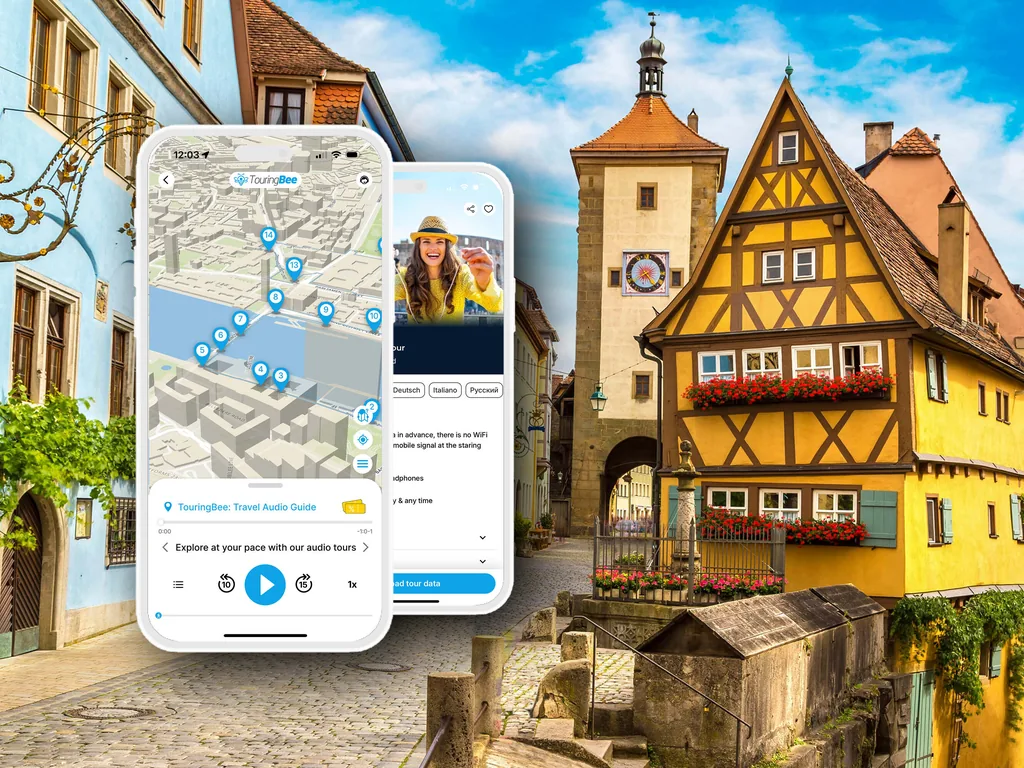
Rothenburg City Walk — Self-Guided Audio TourInstant access
- 100% offline — no Wi-Fi or data needed
- Offline GPS map — you start each track yourself at the spot
- 25 stops from Marktplatz to the Hospital Bastion
- Walk it in 1.5–2 hours, at your own pace
Practical notes
Dates, prices and opening hours verified for the 2026/27 season. Check the official sites before you travel — these change every year.
Weather. Cold and grey more often than crisp and white. December daytime highs sit around 4–5 °C, nights at or just below freezing, with rain more likely than snow. Snow does fall, and when it does the town is remarkable — but do not book a trip on it.
What to wear. You will be standing outdoors in the dark for hours: a proper coat, hat, gloves and shoes that cope with wet cobbles. The wall walk is uneven and unlit in stretches.
Getting there. Rothenburg ob der Tauber has no mainline station — you change at Steinach (b Rothenburg) for the short shuttle, usually from Würzburg, Ansbach or Nuremberg. By car it is off the A7. One winter trap: the Romantic Road Coach does not run in December — it operates only from May to mid-September.
Booking. A few thousand guest beds for a town of 11,400, and Advent weekends inside the walls sell out months ahead. If you want to stay in the old town in December, book in summer.
Frequently Asked Questions
When is the Rothenburg Christmas market in 2026?
The Reiterlesmarkt runs from 20 November to 23 December 2026 and closes for a single day, Totensonntag on 22 November. Hours are 11:00–19:00 Sunday to Thursday and 11:00–20:00 on Friday and Saturday.
Is Rothenburg worth visiting at Christmas?
Yes, if you build the day around the evening. The market is small — 61 stalls — but it sits inside a complete walled medieval town, which is what makes it look the way it does in photographs. Come for the hour either side of sunset rather than the middle of the day.
Is the Christmas market open after Christmas?
No. It ends on 23 December. The week between Christmas and New Year has no market at all — this is the most common mistake people make booking Rothenburg in winter.
What is the Reiterle?
The figure the market is named after. In pre-Christian belief he was a rider who carried the souls of the dead through the winter sky; over the centuries he was softened into a friendly Christmas figure who now opens the market on horseback.
What is the difference between Käthe Wohlfahrt and the German Christmas Museum?
Käthe Wohlfahrt's Christmas Village is a shop, open all year. The German Christmas Museum is a museum upstairs from it, reached by a staircase inside the shop, with an admission charge of €5.
Does it snow in Rothenburg at Christmas?
Sometimes, not reliably. December averages around 4–5 °C by day and near freezing at night, and rain is more common than snow.
Can you visit Rothenburg as a Christmas day trip?
Yes, from Munich, Frankfurt or Nuremberg — but a standard day trip has you leaving before dark, which is when the market is at its best. If you can, stay the night.
Continue exploring
Some outbound links on this site are affiliate links. If you book through one we may earn a small commission, at no extra cost to you. The TouringBee audio guide is our own product. See our Affiliate Disclosure.
Walk Rothenburg With Every Story in Your Ears
Twenty-five stops from Marktplatz to the Hospital Bastion — in December, in the dark, with the lights on.
Get the Audio Tour — from €9.99