Rothenburg Christmas Market 2026: Dates, Map and Tips
The Reiterlesmarkt runs 20 November to 23 December. Here are the four squares, the hour that decides your evening, and the things that catch people out.
Buy the Audio Guide The Day Plan Quick AnswersRothenburg ob der Tauber’s Christmas market is small. Sixty-one stalls, four linked squares, fifteen minutes to walk end to end. If you have been to Nuremberg or Cologne, you will see the whole thing in the time it takes to queue for a Glühwein there.
That is the point. The market is not the attraction — the town is, and the market is what happens inside it. So give the daylight to Rothenburg and come back to the stalls at dusk.
The TouringBee audio guide to Rothenburg runs 25 stops in about ninety minutes, which fits exactly the part of the day when the Christmas lights are still losing to the sky.
Still planning the whole trip? Start with our complete guide to Rothenburg ob der Tauber, or our honest take on Christmas in Rothenburg, then come back here for the market details.
At a glance
- Runs
- 20 November – 23 December 2026
- Closed
- One day only — Totensonntag, Sunday 22 November
- Hours
- Sun–Thu 11:00–19:00 · Fri–Sat 11:00–20:00
- Entry
- Free — no gates, no ticket
- Size
- 61 stalls across four linked squares
- Best hour
- 16:00–17:00, while the sky still holds blue
2026 dates and hours
Two things are worth spelling out, because both catch people.
The market closes on Totensonntag. That is the German day of remembrance for the dead, the last Sunday before Advent. Bavaria shuts down public entertainment and the huts stay shuttered. In 2026 it falls on 22 November — the third day of the market. Book a weekend around that date and you lose your Sunday.
The market ends on 23 December, not after Christmas. There is no market between Christmas and New Year. None. It is the single most common mistake people make booking Rothenburg in winter.
The opening ceremony
Do not confuse the market’s first day with the opening ceremony. The stalls start trading on 20 November; the Reiterle rides in only on the Friday before the first Sunday of Advent.
In 2026 that Friday is 27 November — a week after the market has already opened. The rider comes into the square, greets the crowd, the mayor speaks and the tree is lit. Traditionally the lights go on at 17:00, though the town has not confirmed the time for 2026.
Two consequences. If you want the ceremony, the market’s start date is not the date you want. And if you want the market without the biggest crowd of the season, avoid that Friday evening.
The map: four squares and how they connect
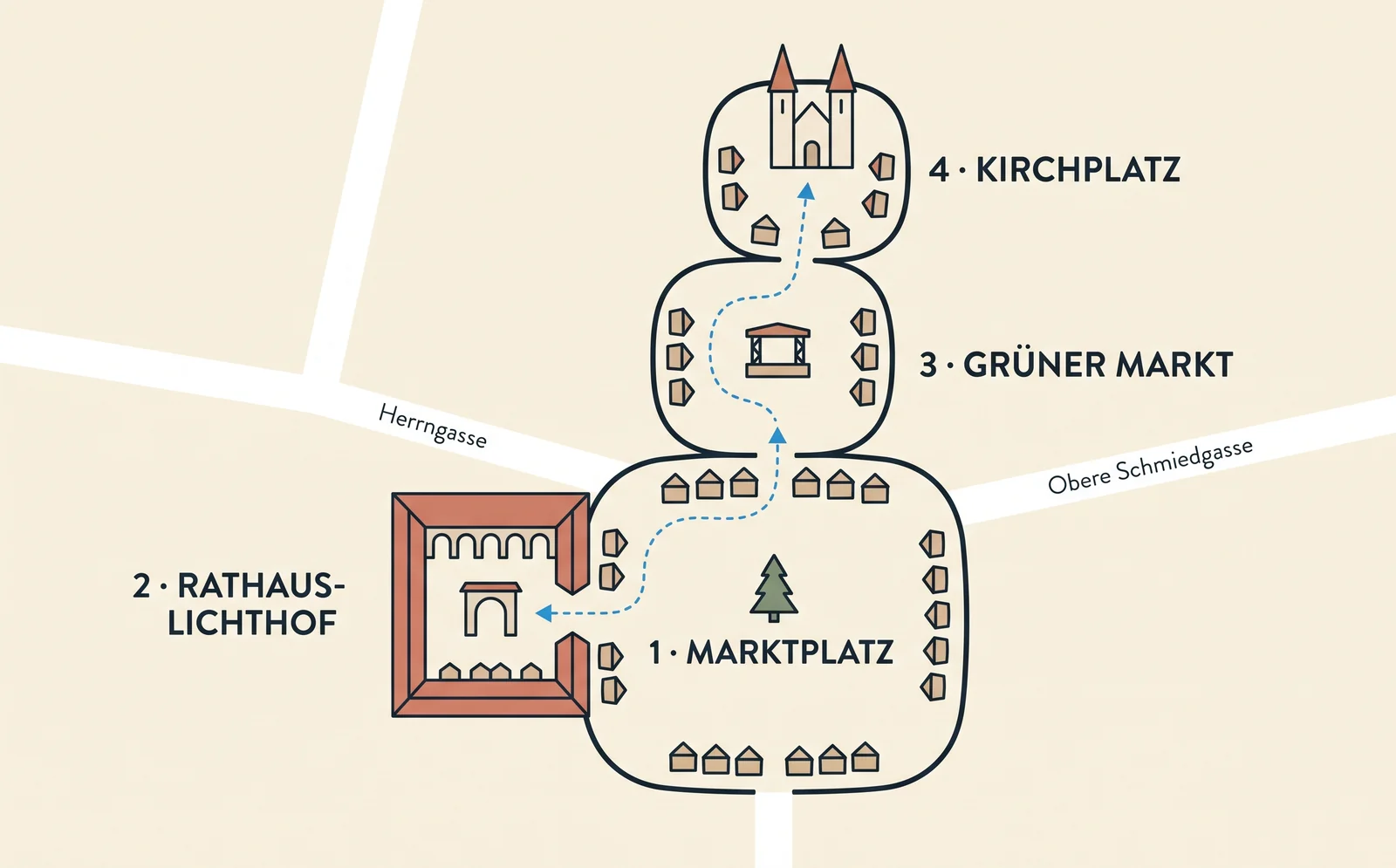
Forget a stall-by-stall map — the traders change every year and any list goes stale. What does not change is the shape. The market fills four spaces that run into each other, and walking them in order takes fifteen to twenty minutes without rushing.
1. Marktplatz — the main square, in front of the town hall. The tree stands here and this is where the ceremony happens. The Ratstrinkstube with its clock is on the north side; the mechanical Meistertrunk figures play every hour from 10:00 to 22:00, so you can catch them with a cup in your hand.
2. The Rathaus Lichthof — the covered arcaded courtyard inside the town hall itself, opening off Marktplatz. Easy to walk past. It is also the only part of the market with a roof over it, which matters in rain and in wind.
3. Grüner Markt — immediately north of Marktplatz. The stage is here, and brass bands from the surrounding Franconian villages play daily. This is the loud end.
4. Kirchplatz — the square by St James’s Church, just beyond. The quietest corner, and the best one after dark: the church windows are lit from inside and you can drink your mug facing them. Worth stepping inside to warm up, too.
The whole thing is flat, cobbled and pedestrian. You enter from any direction; there are no gates and no ticket.
What you will find where
The stalls mix food, drink and craft rather than separating them, so you are never far from either. From the town’s own stall plan last season: woodcarving and horn work, Erzgebirge nutcrackers and Christmas pyramids, wool goods and felt slippers, Christmas stars and light strings, a children’s carousel, a nativity scene, and a dedicated stall for returning your mug.
To eat, look for what you will not find at a market in another town: Schneeballen, Rothenburg’s own, which in winter come in cinnamon-apple and clove; half-metre bratwurst; Käsespätzle, Leberkäse, Schäufele, roast chestnuts, Lebkuchen, Stollen and gebrannte Mandeln. There are vegan soups and vegan bratwurst too, which is newer than the market’s image suggests.
To drink, skip the red Glühwein you know. Franconia drinks it white — Weißer Glühwein, made from local Silvaner and Müller-Thurgau: drier, spiced differently, and poured at almost every hut here. Alongside it, look for Quittenglühwein (quince), Feuerzangenbowle, mead served in a drinking horn, and Franconian Rotbier if you want something that is not sweet.
The mug. Every hot drink carries a deposit, usually €3–4, and one stall does nothing but take mugs back. Keep yours as a souvenir if you like — the deposit is the price and nobody minds. The design changes every season, which makes it the cheapest thing you will take home.
When to go
In mid-December the sun sets over Rothenburg at 16:20, and the market runs to 19:00 or 20:00. So the market is, in practice, an evening event, and it looks like the photographs for about an hour either side of sunset.
- 11:00–15:00 — open but flat: grey daylight, the lights lost in the sky, and the coaches at their peak. They arrive around 10:30 and clear out by 16:00. Use this time for the town, not the market.
- 16:00–17:00 — the hour. Blue sky behind lit stalls and lit windows. If you take one photograph in Rothenburg, take it now.
- After 17:00 — fully dark, warm, busy with the people who stayed. The best time to actually eat and drink.
Quietest: weekday afternoons in the first week. Busiest: the opening Friday, every Saturday, and the two weekends before Christmas.
One more thing about the clock: the market closes, the facade lights do not. After 19:00 on a weekday the garlands are still burning and the streets are all but empty. It is the best hour in Rothenburg and it costs nothing.
A plan that works
Until 15:00 — the town, while there is light: the wall, the Plönlein, Herrngasse, the lanes behind the square. The TouringBee route covers this in about ninety minutes and finishes near the market.
15:00–15:45 — one warm thing: the German Christmas Museum on Herrngasse, or coffee. Note that the Käthe Wohlfahrt shop itself queues from mid-morning right through the afternoon in season — if you want it without the crush, go at the 9:00 opening, before anything else.
16:00–17:00 — Plönlein first, then up to Marktplatz while the blue hour holds. During the market the Town Hall Tower stays open until 18:00, and until 19:00 from Friday to Sunday, so you can go up in the dark: 220 steps, a single-file hatch at the very top, and the ticket desk up there rather than at the bottom, cash only — €4 adult, €2 under 14. From the platform at 52 metres you watch the market light up beneath you.
After 17:00 — eat first, then drink. And watch the Advent window open on the second floor of the town hall: a different one every evening, made by local school classes and youth groups.
Later — a stretch of the town wall in the dark, free and open at any hour. Then the Night Watchman tour at 21:30 if it is running.
And half an hour after the market closes, walk Herrngasse and the Plönlein once more. By day they are the most trampled spots in town; at night you will have them almost to yourself with the lighting still on. That half hour is the reason to sleep inside the walls.
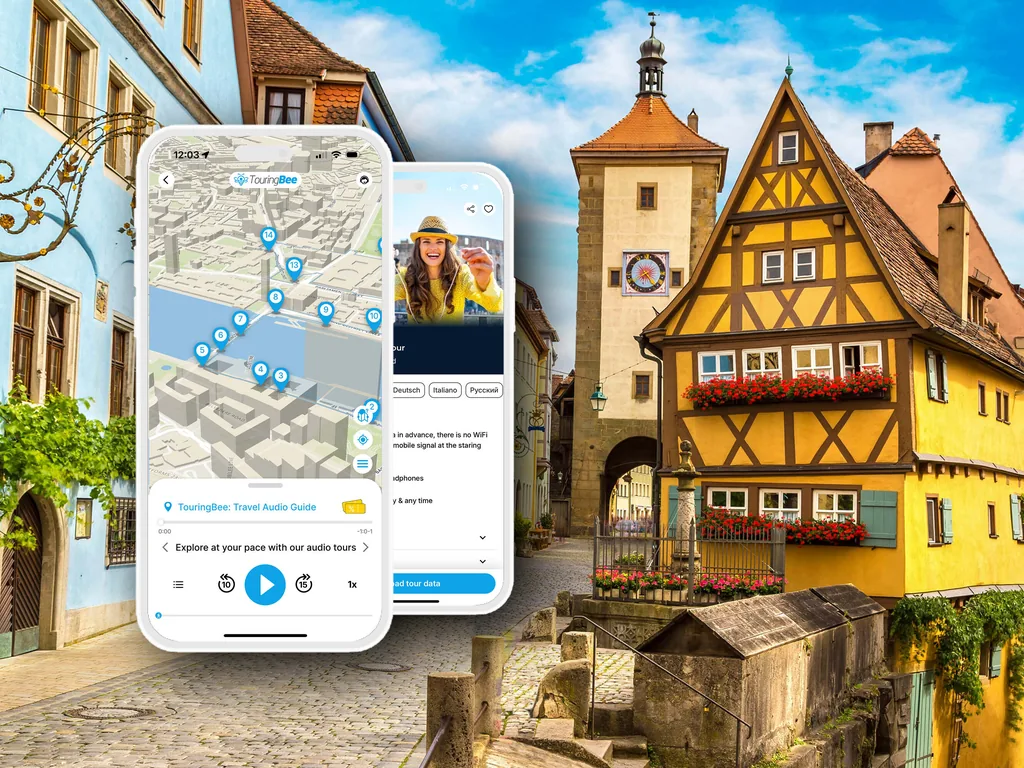
Rothenburg City Walk — Self-Guided Audio TourInstant access
- 100% offline — no Wi-Fi or data needed
- Offline GPS map — you start each track yourself at the spot
- 25 stops from Marktplatz to the Hospital Bastion
- Walk it in 1.5–2 hours, at your own pace
Practical notes
Dates, prices and opening hours verified for the 2026/27 season. Check the official sites before you travel — these change every year.
Cash. Carry some. The Town Hall Tower’s ticket desk is at the top of the climb rather than the bottom and takes cash only, and small stallholders are quicker with it.
Weather. December daytime highs sit a few degrees above freezing, evenings at or around zero, and rain is more likely than snow. What matters more: you will be standing still outdoors in the dark for hours, which is colder than walking, and the wind comes up the Tauber valley along the walls — on the open Marktplatz it bites harder than the thermometer suggests. Proper coat, hat, gloves, thick soles that cope with wet cobbles. The Rathaus Lichthof is the only part of the market with a roof over it.
Getting there. Rothenburg has no mainline station: change at Steinach (b Rothenburg) onto the short shuttle, coming from Würzburg, Ansbach or Nuremberg. By car it is off the A7, with the P1–P5 car parks outside the walls. On an Advent Saturday they fill by lunchtime and a queue builds at the gates, so come before 11:00 or after 16:00. Driving on most old-town streets is closed to visitors between 11:00 and 16:00 — if your hotel is inside the walls, ask it for the access route in advance, because satnavs here regularly send cars into the pedestrian zone. One winter trap: the Romantic Road Coach does not run in December, only from May to mid-September, so any plan built around it fails in Advent.
Dinner. Kitchens in the traditional Gasthöfe close early — after 21:00 hot food is hard to find. If you want a sit-down dinner rather than market food, book a table for 19:00–19:30, right after the huts shut on a weekday.
Beds. A few thousand guest beds for a town of 11,400 people, and Advent weekends inside the walls sell out months ahead. If you want to sleep in the old town in December, book early.
Combining with another market. Nuremberg’s Christkindlesmarkt is the obvious pairing — about an hour and a half by train with the same change at Steinach, and a completely different animal: huge, dense, famous. Check its dates separately, they are not the same as Rothenburg’s. If you are going, the same approach works there: the TouringBee audio guide to Nuremberg takes you through the old town by day and you keep the market for the evening.
Frequently Asked Questions
When is the Rothenburg Christmas market in 2026?
20 November to 23 December 2026. It closes for one day, Totensonntag on 22 November. Hours are 11:00–19:00 Sunday to Thursday and 11:00–20:00 on Friday and Saturday.
Is the Rothenburg Christmas market free?
Yes. There is no entry charge and no ticket. You pay only for what you eat, drink and buy, plus admission to the museums and the tower if you go in.
How big is the Rothenburg Christmas market?
61 stalls across four linked squares — Marktplatz, the Rathaus Lichthof, Grüner Markt and Kirchplatz. Fifteen to twenty minutes to walk the whole thing.
Is the market open after Christmas?
No. It ends on 23 December. There is no Christmas market in Rothenburg between Christmas and New Year.
When is the opening ceremony?
The town holds it on the Friday before the first Sunday of Advent, which in 2026 is 27 November — a week after the stalls open. The Reiterle arrives on horseback and the tree is lit. Traditionally the lights go on at 17:00, though the town has not confirmed the 2026 time.
What should I eat at the Rothenburg Christmas market?
Schneeballen are the local speciality — buy one small one to share, they are dry by design. Otherwise half-metre bratwurst, Käsespätzle and roast chestnuts, with Quittenglühwein or Feuerzangenbowle to drink.
What kind of Glühwein do they drink in Rothenburg?
White — Weißer Glühwein, made from Franconian Silvaner and Müller-Thurgau. It is drier and spiced differently from the red you are used to, and almost every hut here pours it. Also worth trying: quince Glühwein and Feuerzangenbowle.
Can you go up the Town Hall Tower in the evening?
Yes. During the market it is open until 18:00, and until 19:00 from Friday to Sunday, which is well after dark. It is 220 steps with a single-file hatch at the top; the ticket desk is up there and takes cash only — €4 adult, €2 under 14. The platform at 52 metres looks down on the whole lit square.
What is the best time of day to visit?
Between 16:00 and 17:00. The sun sets at 16:20 in mid-December, the lights are already on and the sky still holds blue. Before 16:00 the market looks flat; after 17:30 the blue-hour contrast is gone.
Continue exploring
Some outbound links on this site are affiliate links. If you book through them we may earn a commission, at no extra cost to you.
Walk Rothenburg Before the Lights Come On
Twenty-five stops from Marktplatz to the Hospital Bastion — ninety minutes of daylight well spent, then the market.
Get the Audio Tour — from €9.99