
Walk Rothenburg's City Walls: The Tower Trail, and Which Stretch to Pick
Free, mostly open around the clock, and rebuilt after 1945 with money raised by the metre.
Get the Audio Guide The Donor Stones Quick AnswersAt a glance
- The wall
- About 4 km around the old town, 42 towers, six gates
- Cost
- Nothing. Large parts of the walkway are open around the clock
- Underfoot
- Uneven boards under a tiled roof, narrow, slippery when wet
- Getting up
- Stairs at the gates — the Rödertor and the Galgentor, also called the Würzburger Tor, among them. No lifts
- The whole circuit
- The marked Tower Trail, about 4 km, roughly 2.5 hours by the town's reckoning
- If you walk one stretch
- Klingentor to Rödertor, late in the day
Rothenburg's wall is the reason the town looks the way it does, and it is one of the few major sights here that costs nothing at all. You can climb onto it at a gate, walk a covered wooden gallery above the back gardens nobody sees from the street, and come back down at the next gate. No ticket, no turnstile, no opening hour for most of it.
What almost nobody tells you on the way up is that a good part of the wall you are standing on is younger than your grandparents, and that it was paid for by strangers whose names are cut into the stone beside you.
The wall was bombed, and then bought back by donation
On 31 March 1945, sixteen aircraft bombed Rothenburg. Thirty-seven people were killed, around 275 houses went, along with six public buildings, nine towers and roughly 600 metres of the wall. The eastern side took the worst of it — the quarter around the Rödertor, which is exactly where most visitors now climb up.
The town could have left the gaps. Instead, in 1950, the local Arbeitsgemeinschaft für Wiederaufbau put forward a plan to rebuild the wall, and the money was asked for by the metre. The appeal went out worldwide at 59 German marks per metre of wall. By May 1953 the repair was fully covered by donations.
The donors got their names in the wall. Walk the eastern stretch slowly and you will see them: small inscribed stones and plaques set into the parapet, each with a name and a home town — people from Rothenburg, and people from places that had no other connection to this town than having heard it was in pieces.
The scheme never closed. The town still takes donations for a stone, on terms published by the Stadtkämmerei: a donation stone starts at 1,500 euros, and the town carves the donor's name and home town into it — two or three lines, 35 characters in total. You write to the town treasury first and transfer afterwards. Taken together, the old-town donation fund still brings in around 20,000 euros a year, most of it from Germany and the United States.
One stretch had been a ruin long before the war: the Staffelmauer, already derelict in the nineteenth century, was restored afterwards and made walkable, so part of what you cross was a gap for generations before it was a path.
So the standard line about Rothenburg — that it is a perfectly preserved medieval town — is not quite the story. Part of it is a careful rebuild, and the receipts are on display.
The TouringBee audio guide covers 25 stops around the old town, offline and at your own pace — the same streets, with the story attached.
Two walls, not one
Look at a map of the old town and the wall has an odd shape: a long oval with a kink in the middle. That is because Rothenburg outgrew its defences and built a second ring.
The older, inner wall enclosed the original town, and two of its towers still stand inland, surrounded by houses, nowhere near the edge: the Markusturm and the Weißer Turm. If you have wondered why there is a medieval gate tower in the middle of a shopping street, that is why — it used to be the edge.
The outer ring, the one you walk today, took in the newer quarters to the south and east, and the Spitalbastei at its southern tip is the latest and heaviest piece of the system.
What the walkway is actually like
Up the stairs, turn right. You are on a covered wooden walkway — tiled roof overhead, arrow slits at eye level, and a view down into back gardens you never see from the street. About twenty minutes at a normal pace. The boards are uneven and the passage is narrow enough that two people pass sideways; in the wet it is slippery. No ticket, no gate.
It is darker than you expect, and louder — your own footsteps on boards, under a roof, with stone on one side. Through the arrow slits you get the thing that makes the wall worth walking: not the famous views, but the ordinary ones. Washing lines. A parked bicycle. Somebody's greenhouse. The backs of houses whose fronts are photographed ten thousand times a day.
There are no toilets on the wall and nowhere to buy water. The car parks at the gates have both.
The Tower Trail is not the same thing as the walkway
Two routes get confused, and they are different walks.
The walkway. The Wehrgang is the covered gallery on top of the wall. It is not continuous: it runs in stretches, with gaps where the wall was never rebuilt that high or where a gate interrupts it. You go up and down at the gates.
The Tower Trail. The Rothenburger Turmweg is a marked route of about 4 km that goes around the old town at ground level, beside the wall rather than on it. The town puts it at roughly 2.5 hours, starting from the Röderturm, with information boards along the way about the 42 towers. The 2026/27 town catalogue counts 22 marked stations on it.
The practical difference: the tourist office describes the Tower Trail as almost barrier-free, which makes it the better option if stairs are a problem. The walkway is not — you reach it by stairs at the gates, and there are no lifts anywhere on it.
Don't walk all of it
A long stretch of uneven boards under a low roof is a long time in a corridor, and the wall starts to feel like one. Most people enjoy about forty minutes of it and then want the street back.
Two stretches are worth choosing over the others.
Klingentor to Rödertor, the northern run. If you only walk one stretch, walk this one, and do the eastern stretch first so you come to it second. Rejoin the walkway on the north side. This stretch usually feels calmer than the central streets, and it is at its best in low evening light. From the gallery near the Röderbastei you look down on the Gerlachschmiede and its distinctive triangular roof — the view most people only get from street level. Twenty minutes, and you are back at the start.
Rödertor south to the Spitalbastei, the eastern run. This is the rebuilt section, so it is also the donor-stone section — the one where it is worth slowing down and reading the parapet. Walk through the southern bastion rather than past it: two inner courtyards and a sequence of gateways let you feel the thickness of the defences in a way the street never does. Five minutes, free. Approaching on foot from the south gives you the full depth of the gates.
Over the main gate of the Spitalbastei there is an inscription that reads Pax intrantibus — peace to those who enter. It is a strange thing to carve on the most heavily fortified entrance in town, and it is the last thing you read on the way out.
What you see from up there, stretch by stretch
The wall is low — you are a storey or two above the street, not above the rooftops — so this is not a panorama. It is a sequence of close looks, and each side gives you a different one.
North, Klingentor to Rödertor. Roofs, and the best of them. The ground falls away slightly here, so you look across tiles rather than down at them, and in the last hour of daylight the whole field of them turns orange.
East, Rödertor to the Spitalbastei. The rebuilt side, and the plainest architecturally — which is the point: this is where you read the parapet instead of the view. Back gardens, sheds, the ordinary life of a town of about eleven thousand four hundred people that takes two million visitors a year.
South, around the Spitalbastei. The defences get serious. Two courtyards, gateways one after another, and from the top of the bastion a long view out over the plain the attackers would have crossed.
West. There is barely any walkway on this side, and you do not need one: the ground drops straight into the Tauber valley, and the Castle Garden at the western tip gives you the view the wall never had to defend, because the cliff did it instead.
The one tower you can climb
Forty-two towers, and exactly one of them lets you up: the Röderturm, which the town's own catalogue calls the easternmost and the only climbable tower of the town wall. It is 103 steps to the tower room, 3 euros for adults and 1.50 under 18.
The hours are short and seasonal: daily 11:00–14:00 from June to August, and weekends and public holidays in April, May, September and October. Outside those windows it is closed, so do not build a day around it.
Inside there is a photo exhibition of the town after the 1945 raid, which is the right place to see it — you are standing in a tower that burned out to its walls that night and was rebuilt.
The other climb in town, the Town Hall tower, is not part of the wall: 220 steps, a platform at 52 metres, 4 euros adult and 2 under 14, cash only, and the ticket desk is at the top.
Where to get on and off
- Rödertor. The eastern gate and the usual starting point: car park P1 is just outside, the station is about ten minutes' walk, and there is a marked staircase onto the wall right at the gate.
- Klingentor. The northern gate, and the tower has St Wolfgang's Church built into it — from the field side a fortification with heavy walls and firing slits, from the inside a late Gothic church with three altars from around 1500. The town's catalogue calls it the church with the cannon chamber behind the altar. Adults 4.50 euros, and the opening days are narrow: weekends from April to July and in September and October, Wednesday to Sunday in August, closed from November to March.
- Spitalbastei. The southern tip, free, and the best place to start if you are arriving from car park P5.
- Burgtor. West. Not a walkway access point for most people, but the way through to the Castle Garden and the valley views.
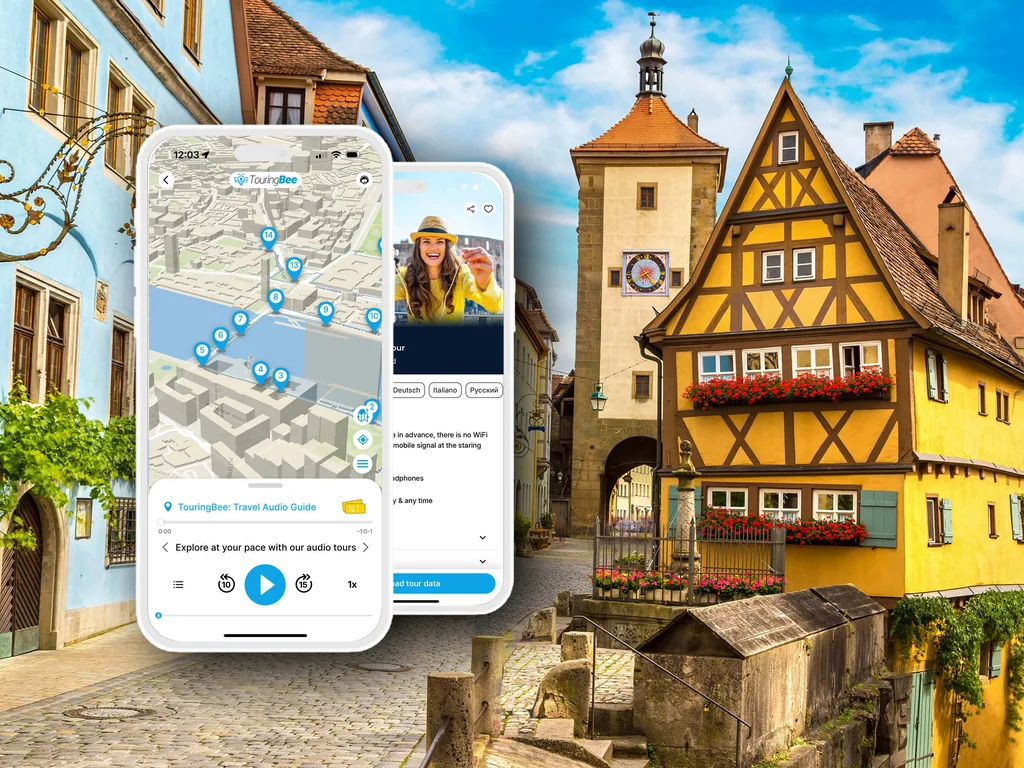
Rothenburg City Walk — Self-Guided Audio TourInstant access
- 100% offline — no Wi-Fi or data needed
- Offline GPS map — you start each track yourself at the spot
- 25 stops from Marktplatz to the Hospital Bastion
- Walk it in 1.5–2 hours, at your own pace
Practical notes
Shoes before weather. The whole old town is medieval cobble and the boards on the wall are uneven; wet boards under a roof stay wet for a long time after the street has dried. Flat soles with some cushioning.
It is not lit. Large parts of the walkway are open around the clock and cost nothing — but open is not the same as lit. The walkway has no lighting, so after dark you are on uneven boards with a phone torch, and the famous evening view of the roofs is better from the street or the Castle Garden.
Sections do close. Individual stairways and stretches shut for repairs, weather or safety, and the town does not publish a live list. Have a second way down in mind rather than counting on one particular staircase.
Winter. The wall is open and free in winter too, and the cold is not the problem — the problem is that the boards ice over in the shaded stretches, and the sun is off the roofs by about 16:20 in mid-December.
Prams and wheelchairs. Not on the walkway. Take the Tower Trail at ground level instead.
Frequently Asked Questions
Can you walk Rothenburg's city walls for free?
Yes. Large parts of the walkway are open around the clock and cost nothing. There is no ticket and no turnstile; you go up by the stairs at the gates. The only tower on the wall you pay to climb is the Röderturm, at 3 euros.
How long does it take to walk the whole wall?
The marked Tower Trail runs about 4 km around the old town and the town puts it at roughly 2.5 hours. Walking only the covered stretches of the wall itself takes less, because the walkway is not continuous. Most people are satisfied with about forty minutes on it.
Which section of the wall is the best?
Klingentor to Rödertor in the late afternoon, for the light on the roofs. The eastern stretch from Rödertor down to the Spitalbastei is the one with the donors' names in the parapet.
Why are there names carved into the wall?
They are donors. After the 1945 air raid the town rebuilt the damaged wall with money raised worldwide at 59 marks a metre, fully funded by May 1953, and the donors' names and home towns were cut into the stone. You can still donate for a stone today, from 1,500 euros.
Is the wall wheelchair accessible?
The walkway is not: you reach it by stairs and there are no lifts. The tourist office describes the Tower Trail, which runs at ground level beside the wall, as almost barrier-free.
How many towers and gates does Rothenburg have?
The town counts 42 towers and six gates through the wall, plus a few small pedestrian doors.
Can you walk the wall at night?
Most of it is open, but none of it is lit. It is not a good idea on uneven boards, and the view is better from the street anyway.
Is the wall original or rebuilt?
Both. Most of it is medieval; roughly 600 metres were destroyed in 1945 and rebuilt in the early 1950s, mainly on the eastern side around the Rödertor.
Continue exploring
Some outbound links on this site are affiliate links. If you book through them we may earn a commission, at no extra cost to you.
Walk the Wall, Then Hear What It Was For
Twenty-five stories along the old town, written by historians and fully offline.
Get the Audio Guide — from €9.99