
Rothenburg in Winter: Weather, Crowds and What Stays Open
Advent, the empty fortnight, and January to March — three towns wearing the same walls.
Get the Audio Guide The Three Winters Quick AnswersAt a glance
- Three different towns
- Advent, the empty fortnight, and January to March
- Temperature
- 3–4 °C by day, −1 to −3 °C at night. January is the coldest
- Snow
- About one snow day a month. Rain is likelier
- Daylight
- About eight hours in December, nearer twelve by March
- The winter bonus
- In December the lit hour starts at 16:20 — a day trip can reach it
- The winter cost
- Short museum hours, and some things shut entirely
Rothenburg ob der Tauber sells itself in winter on one image: half-timbered gables under snow, lit windows, a Christmas market below. That image is real. It is also the least likely version of the town you will get.
Winter here is not one season but three, and they are so different that advice written for one is actively wrong for the others. This page separates them, says what is actually open in each, and gives the weather as numbers rather than as a mood.
Planning the trip itself? Start with the complete guide to Rothenburg ob der Tauber, the Christmas market dates and map, or where to stay.
The weather, without the postcard
Winter in Rothenburg is cold, grey and damp more often than it is white.
- December
- 3 °C by day · −1 °C at night · about 5 cm of snow in the month
- January
- 3 °C by day · −3 °C at night · about 5 cm of snow in the month
- February
- 4 °C by day · −2 °C at night · about 4 cm of snow in the month
The number that matters is not the snowfall total but how it arrives. Across December, January and February the town averages roughly one snow-only day a month, against roughly five to six days of plain rain. The snowy Rothenburg in the photographs is a lucky morning, not a season. Plan for grey and wet, and treat snow as a bonus if it happens.
Daylight is the other constraint. December gives about eight hours of it, January a little more, and by late March you are back to roughly twelve. The earliest sunset of the year is 16:20, on 11 December, and the latest sunrise is about 08:15, at the turn of the year. In practice you get usable light from roughly 08:30 to 16:00.
That sounds like a loss. In one respect it is the opposite.
The winter advantage that gets left out
The best hour in Rothenburg is the one after the day visitors leave, when the lighting comes on and the lanes empty. In June that hour falls around 21:00, which you can only reach by staying the night.
In December it falls at about 16:20, which a day visitor leaving at 17:30 can still reach.
This is where a December day trip beats a summer one. If you arrive at 11:00 and leave at 17:30, you will have seen the town in flat midday grey and in the blue half-hour that the summer day-tripper never gets. The advantage shrinks as the days lengthen: by late February sunset is past 17:30 again, and the argument is back to normal. Staying the night is still better. But winter is the one season where not staying is not a disaster.
Winter one: Advent, 20 November to 23 December
Hours and prices verified for the 2026/27 winter against official sources. Check before you travel — winter schedules change more than summer ones.
This is the Rothenburg the images are selling, and the part of winter when most things are running.
The Reiterlesmarkt opens 20 November and closes 23 December 2026, shut for one day on Totensonntag, 22 November. Museums are already on winter hours but still open daily, the Night Watchman runs every evening, the Town Hall Tower switches to its market-day hours — 10:30–14:00 and 14:30–18:00, to 19:00 Friday to Sunday, and the old town decorations are up.
It is also the busiest the town gets outside high summer, and on Advent weekends the old town closes to traffic for part of Saturday and Sunday. If Advent is what you came for, the Christmas market guide has the dates, the four squares and the hour that matters.
Rooms for Advent weekends go early. Check what is still free for your dates before fixing anything else.
Winter two: the empty fortnight, 24 December to early January
This is the part that gets skipped, and it is the most interesting.
On 24 December the market is gone. Not winding down — gone. The huts come down, the squares empty, and the coach parties stop. What stays is the town itself, with its street lighting and its old-town decorations still up, and almost nobody in it.
If you want the medieval town without the crowd, this is when it exists. It is also when the least is open:
- The Medieval Crime Museum runs 11:00–16:00 to 6 January, last entry 15:15. On 24 and 31 December it opens 10:00–13:00 only.
- The German Christmas Museum runs daily 10:00–17:00 until 23 December and then closes. Its next published hours start in mid-January, so treat the gap as shut and check if you need it.
- Käthe Wohlfahrt's Christmas Village stays open daily, as it does all year.
- The wall is free, open and unaffected.
- The Night Watchman keeps running to 23 December, then stops until January.
Two practical warnings. Franconian kitchens take the holidays seriously, so check that your restaurant is open rather than assuming. And this is the coldest, darkest, wettest fortnight of the year — it rewards a town you can walk in twenty minutes and a room you can retreat to.
Winter three: January to March
The quietest and cheapest Rothenburg, and the most shuttered.
- Medieval Crime Museum: 13:00–16:00 from 7 January, last entry 15:15. Three hours a day.
- German Christmas Museum: restricted hours from mid-January, and it may close altogether for renovation and exhibition work. Check before making the trip for it.
- Town Hall Tower: weekends only, 12:00–15:00, January to March. €4 adult, €2 under 14, cash only, desk at the top.
- Röderturm: €3 adult, €1.50 up to 18 — but from November to March it opens by weather and prior arrangement only, which covers Advent too. Do not plan around it in any of the three winters.
- Night Watchman: Saturdays only from 7 January until late March — English at 20:00, German at 21:30.
- The wall: open, free and at its emptiest. Also at its most slippery.
What you get in exchange is a walled medieval town with almost no one in it, at the lowest room prices of the year. What you give up is most of the indoor hours, which in a month averaging three hours of museum opening is not a small thing.
What is open all winter, whatever happens
- The town wall. Free, and most of the walkway is open at any hour. It has a roof, which in Rothenburg's winter matters more than the view.
- Käthe Wohlfahrt's Christmas Village, daily 10:00–18:00, year-round. On a wet February Tuesday it is the only place in town where it is still December.
- The lanes themselves — the Plönlein, Herrngasse, the Burggarten, the quiet streets behind the square. Free, open, and emptier than you will ever see them in summer.
- Churches, on their own winter hours.
Which is the honest answer to "is there anything to do in Rothenburg in January": yes, if walking a medieval town in the cold is the thing you came for. If you need indoor hours to fill a day, no.
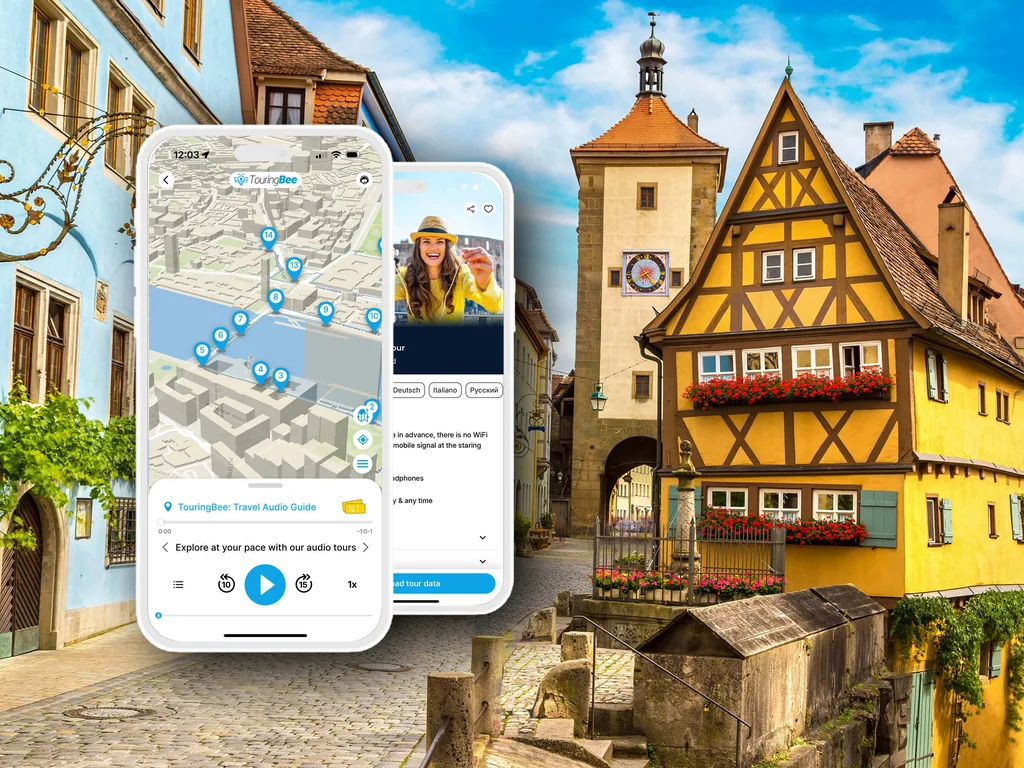
Rothenburg City Walk — Self-Guided Audio TourInstant access
- 100% offline — no Wi-Fi or data needed
- Offline GPS map — you start each track yourself at the spot
- 25 stops from Marktplatz to the Hospital Bastion
- Walk it in 1.5–2 hours, at your own pace
What to wear and what to expect underfoot
The cobbles are the problem, not the cold. Medieval cobblestone is uneven at the best of times; wet, it is slippery, and the wooden boards on the wall walkway are worse. Flat soles with grip, not fashion boots.
The wall walkway has a roof but no heating and no walls on one side. Wind comes up the Tauber valley along the fortifications, and the open square is colder than the thermometer says.
Layers, and something waterproof. Rain is the likeliest weather, not snow.
Short days mean an early start. If you want the town in daylight, you are working with 08:30 to 16:00.
Cash. The Town Hall Tower takes cash only, and so do several smaller places.
Walking it in the cold
Ninety minutes outdoors is a long time in February, which is the argument for knowing what you are looking at rather than wandering until you are cold.
Why does the wall have two rings? What happened here in 1945, and whose names are carved into the stones along it? What legend do the clock figures act out every hour? And who was Toppler?
The scripts are written by historians, which is why the answers are specific rather than the single line a guidebook gives you.
25 stops, about 90 minutes, an offline map that shows where you are, and audio you start yourself at each point — so you can break it into two short walks with a warm hour in between, which in winter is how it should be done.
25 stops · about 90 minutes · 7 languages · fully offline · from €9.99
So when should you come?
For the market and the lights: the first half of Advent, midweek. The market runs from 20 November, the crowd builds through December, and a Tuesday in late November gets you the same huts with a fraction of the people.
For the empty town: the last week of December or the first of January. Decorations still up, market gone, almost nobody there, and the shortest museum hours of the year. A trade worth making if the town is what you want.
For the lowest prices: February. Also the fewest open doors.
Not for snow. You cannot plan a trip around roughly one snow day a month. If it happens while you are there, it is a gift.
If you would rather not organise the travel yourself, compare organised day trips from Munich, Frankfurt and Nuremberg — and in winter, unusually, a day trip can still catch the good hour.
In short
Winter in Rothenburg is three towns wearing the same walls. Advent is the famous one and the busiest. The fortnight after Christmas is the emptiest and the strangest, and the one most worth the cold. January to March is cheap, quiet and half-shut.
Whichever you pick, bring grip and a waterproof, start early because the light goes at four, and do not build the trip around snow that probably will not come.
Frequently Asked Questions
Is Rothenburg worth visiting in winter?
Yes, with the right expectations. Advent is the town at its most atmospheric and its busiest. January and February give you an almost empty medieval town at the lowest prices of the year, but with short museum hours and some sights closed.
Does it snow in Rothenburg?
Rarely enough that you cannot plan around it. December, January and February each average about one snow-only day, and five to six days of plain rain. Total snowfall is roughly four to five centimetres a month.
How cold does Rothenburg get in winter?
About 3–4 °C by day and one to three degrees below freezing at night. January is the coldest month, averaging 3 °C by day and −3 °C at night.
What is open in Rothenburg in January?
The town wall, the lanes and Käthe Wohlfahrt's Christmas Village. The Medieval Crime Museum opens 11:00–16:00 to 6 January and 13:00–16:00 after that, the Town Hall Tower weekends only 12:00–15:00, the Night Watchman on Saturdays from 7 January, and the German Christmas Museum on restricted hours or not at all.
What time does it get dark in Rothenburg in December?
The earliest sunset is 16:20, on 11 December. You have usable daylight from roughly 08:30 to 16:00.
Is the Christmas market open after Christmas?
No. The Reiterlesmarkt closes on 23 December 2026, so there is no market on Christmas Eve, over Christmas itself, or between Christmas and New Year. The town's lighting and decorations stay up.
Can you walk the town wall in winter?
Yes. Most of the walkway is open and free at any hour, and it has a roof. The boards get slippery when wet, so it needs shoes with grip.
Continue exploring
Some outbound links on this site are affiliate links. If you book through them we may earn a commission, at no extra cost to you.
Know What You Are Looking At, Even in the Cold
Twenty-five stops, about ninety minutes, written by historians and fully offline.
Get the Audio Guide — from €9.99