
Rothenburg ob der Tauber Guide › Self-Guided Walking Tour

Rothenburg on Your Own: A Self-Guided Walk with the TouringBee Audio Guide

Marktplatz to the Hospital Bastion. Twenty-five stories on your phone, offline, at your own pace.

★ 4.7 app rating1.5–2 hours25 stories7 languagesoffline€9.99
Buy the audio guide — €9.99 How it works

The short answer

Rothenburg can be walked on your own and almost for nothing. The streets are just streets: Plönlein, Marktplatz, the lanes and the Castle Garden cost nothing, and the open stretches of the covered walkway on the town wall are free to walk too. You pay only to go inside things: the Town Hall tower €4, St James’s Church €3.50, the Medieval Crime Museum €10.50.

The TouringBee audio guide does not add the town’s history itself — you can read that beforehand or carry a guidebook. What it adds is order and place. Twenty-five stories are arranged along one route from Marktplatz to the Hospital Bastion, and each one starts where it happened: at this house, in this gateway, on these stairs. On your phone, offline, €9.99 per person.

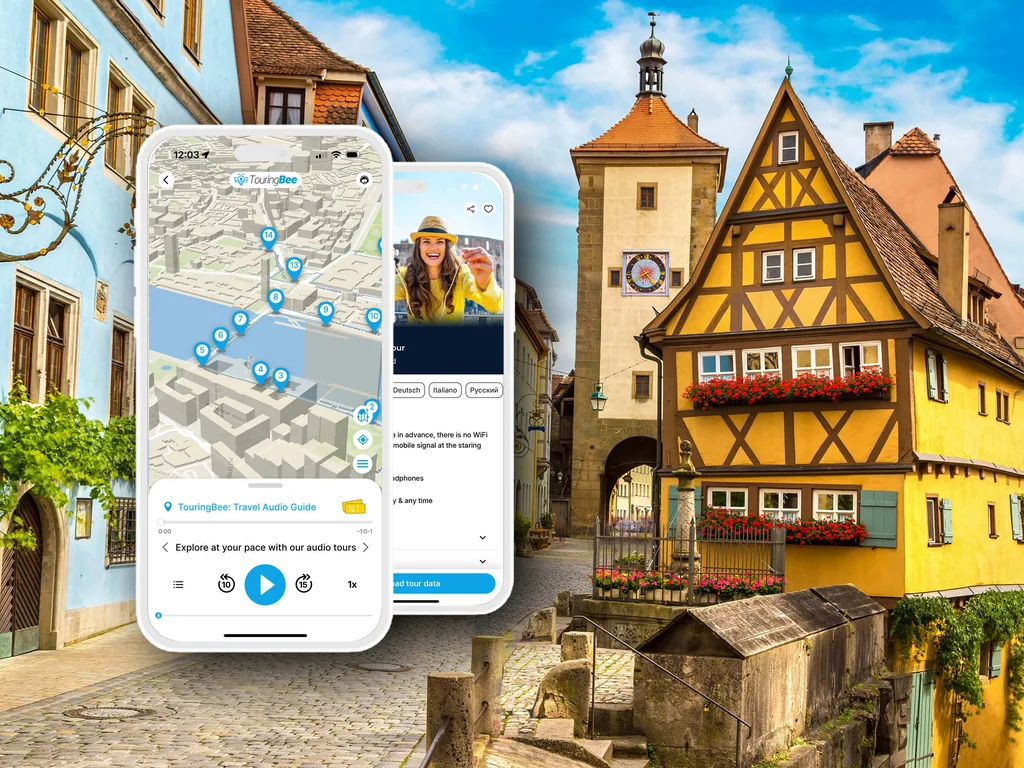
A story screen in the TouringBee app

Planning to walk Rothenburg on your own?

The TouringBee audio guide follows a route of 25 stories — from Marktplatz through Judengasse and the Castle Garden to the Hospital Bastion. On your phone, offline, at your own pace.

Rothenburg audio guide — €9.99

Why it is better with audio

The stories stand where they belong. A church built into a town gate is easy to walk past without noticing that the field side has no windows. The story starts where the thing worth looking at actually is.

You go at your own pace. You start each track yourself and stop whenever you like: sit on the steps, duck into a café, walk back to a house you liked. No group waits for you, because there is no group.

No signal needed. The tour downloads in advance and runs fully offline — no Wi-Fi, no roaming, no dependence on reception in lanes walled in stone.

Hear how the walk begins

About a minute, in the language of this page.

One story in full: the church that shoots back

Picture a church with a chamber for cannon behind the altar. Not as a figure of speech: it was built at once as a place of worship and as part of the town’s defences. From the field side, outside the Klingentor gate tower, it reads as a fortification — heavy walls and firing slits, and behind them, in the town’s own words, casemates, a dungeon and a gun floor. From the inside it is a late Gothic church with fine stone tracery and three altars from around 1500. The town’s own catalogue calls it “the church with the cannon chamber behind the altar”.

Why it turned out that way. Shepherding and the wool trade were serious business in Rothenburg, and the shepherds venerated St Wolfgang — protector of flocks — at a prayer site in front of the gate. Between 1475 and 1492 they built their church there, and they built it as a Wehrkirche, a fortified church. The spot was exposed, with open plain on the far side and no natural defence. Its form, the town writes, has come down unchanged.

And only now, the wolf — because it is the best known and the most misleading thing about this church. The tale is a legend, and it is not a Rothenburg legend but an Austrian one, about a church on the Wolfgangsee. St Wolfgang set out to build in the Alps, the work would not go, and the devil came out of the woods with an offer: one night’s work for the first soul through the door. By morning the church stood. Wolfgang opened the doors — and in ran a wolf, ahead of a hunter. “There is your soul.” Ever since, the saint is painted with a wolf, which is why there is a wolf here in Rothenburg too, though the story itself happened in Austria, some three hundred kilometres away.

There are 25 stories like this on the route.

The route: 8 stages, 25 stories

Below are the 8 main stages of the walk. In the app the route is divided into 25 audio stories, with further stops and illustrations.

  1. Marktplatz

    The start. The town hall, the gabled fronts of the merchants’ houses, and the clock on the Ratstrinkstube: by the town’s own flyer the figures come out every hour from 10:00 to 22:00, and the show lasts about a minute. The Christmas Museum is a few steps away on Herrngasse. If you want height, the Town Hall tower is right here: 220 steps, a platform at 52 metres, €4 adult and €2 under 14, open 9:30–12:30 and 13:00–17:00 daily from April to October, at weekends 12:00–15:00 from January to March and in November, and during the Christmas market daily 10:30–14:00 and 14:30–18:00, until 19:00 from Friday to Sunday. Two things to know first — it is cash only, and the ticket desk is at the top, at the end of the climb. The last stretch is a narrow single-file squeeze, so skip it if tight spaces are not for you.

  2. Judengasse and the northern defences

    Noticeably quieter than the shopping streets: old half-timbering with almost no souvenir windows, and after Marktplatz you can hear the difference. Then the Powder Tower and the Klingentor gate tower in the north-west, where the route steps up onto the wall. There is not a ticket desk or an opening time on this stage, so it works at any hour and in any season. If you walk it in the evening, note that the lanes are lit more dimly than the shopping streets.

  3. Three churches

    Opening hours matter more here than on the other stages: none of the three is open all the time. St Wolfgang’s is inside the Klingentor gate itself, €4.50 adult, and not open every day — weekends from April to July and in September and October, Wednesday to Sunday in August, closed from November to March. St James’s was built between 1311 and 1485, more than a hundred and seventy years, and holds Tilman Riemenschneider’s Holy Blood altar of around 1500, Friedrich Herlin’s Twelve Apostles altar of 1466 with the oldest known depiction of the town, and stained glass six hundred years old; €3.50 adult, free under 12; 10:00–18:00 from April to October, 12:00–15:00 from January to March and in November, 10:00–17:00 during the Christmas market. The Franciscan church is one of the oldest in town, consecrated in 1309, with Riemenschneider’s St Francis altar of 1490 and a rare surviving rood screen; it runs no tours and photography inside is not allowed.

  4. The Burgtor gate and the Castle Garden

    The widest way out of town, and beyond it the garden on the western tip of the ridge, on the site of a castle that is no longer there. Entry is free, and the view opens on the Tauber valley and the southern fortifications: if you would rather not climb the tower, the panorama here is different rather than lesser. Two descents into the valley start here as well, if you have the time and the legs for the climb back: about 15 minutes down the Eselssteige to the Topplerschlösschen, the mayor’s tower house of 1388, and about 20 minutes to the church of St Peter and Paul in Detwang.

  5. Burggasse: crime and Franconian food

    The Medieval Crime Museum at Burggasse 3–5, €10.50 adult, is open daily 10:00–18:00 with last entry at 17:15. In winter the day is shorter: 11:00–16:00 from 2 November to 6 January, then 13:00–16:00 until the end of March, with last entry at 15:15 through both. Inside are more than fifty thousand objects and a thousand years of legal history, and its strength is not the instruments of torture everyone expects but everyday shame: the masks and collars people were made to wear in public. This stretch is also the food one: Schneeballen in every other window, and the Franconian mulled wine that is made white here, from Silvaner, where most of Germany serves it red.

  6. Markusturm, the Craftsmen’s House, the Röderturm and the Gerlach forge

    The eastern side of the old town. The Craftsmen’s House is a medieval dwelling, now a small museum of working life: weavers, shoemakers, potters. The Röderturm is, by the town’s catalogue, the easternmost and the only tower of the town wall you can climb: 103 steps to the tower room, €3 adult and €1.50 under 18, but the hours are seasonal — daily 11:00–14:00 from June to August, weekends and holidays in April, May, September and October. The tower burned out to its walls at the end of the war. The Gerlach forge, with its triangular roof, is best seen from above, from the gallery by the Röderbastei — the angle does not exist from street level.

  7. The southern wall and Plönlein

    Here the route climbs onto the covered galleries: a tiled roof overhead, firing slits at eye level and a view down into back yards you cannot see from the street. Then Plönlein, the fork with the yellow half-timbered house, a fountain and a tower on either side — the most photographed view in town. In season there is usually a queue of people photographing it; it is quietest early, roughly 07:00 to 08:00, and again towards evening.

  8. The hospital quarter and the bastion

    From Plönlein down Spitalgasse into the hospital quarter — a separate piece of town that grew out of an almshouse founded around 1280 to take in pilgrims, the old and the sick. On the way, the hospital church of the Holy Spirit at Spitalgasse 46, foundation stone 1281, open daily 9:00–17:00 and until 18:00 in summer, free. The small house with the conical roof in the middle of the yard is the Hegereiterhaus. The finish is the Hospital Bastion: two inner courtyards, a double ring of walls and a run of gate passages worth walking through rather than past. The thickness of the defences does not read from the street.

The route does not cover every street and does not go inside the sights — it is the town’s main line, not a complete circuit of it.

Did you know? The marked trail along the wall, the Rothenburger Turmweg, runs about 4 km around the old town and has 22 stations. It is a separate walk from this route, which uses only two stretches of the wall.

On your own, with audio, or with a guide

On your own

€0

Any time · your own route · the history is on you: read it beforehand, carry a guidebook, or take it from the signs on site.

With the TouringBee audio guide

€9.99 per person

One payment · a year of access · no fixed start time · 25 stories and an offline map · seven languages — English, German, French, Spanish, Italian, Polish and Russian — each person picks theirs in the app · your own pace, no group to keep up with · it is per person, and there is no child rate, so for a family the guided walk can work out cheaper.

With a live guide

€8–9 per person

The town’s official Stadtführung meets on Marktplatz in front of the town hall, about 90 minutes, does not go inside the sights · €8 adult in German and €9 in a foreign language, €4 and €4.50 for ages 12–17, free under 12 · cash only · you can ask a question and get a real answer, which no recording does · in exchange, a fixed time, the pace of a group, and the language on a timetable.

One thing to check before you count on the guided walk: the foreign-language dates. For the 2026/2027 season the English tour runs 1 May to 11 October and 20 November to 23 December, daily at 14:00; the Spanish one 1 July to 10 October on Wednesdays and Saturdays at 14:00; the Italian one on Saturdays in August at 11:00. That leaves two windows with no foreign-language tour at all — 12 October to 19 November, and 24 December to the end of April — and the town has announced a price increase for 2027. The timetable is republished every season, so it is worth checking the town’s calendar before you travel.

In all three cases, tickets to the museums and the tower are extra.

How it works

Buy it

€9.99, one payment.

Get the email

Activation instructions arrive within 3–5 minutes. Activate before you start walking.

Install the app

TouringBee for iPhone or Android, and pick your language.

Download the tour in advance

After that GPS shows where you are, the stories wait at their stops, and you can pause at any moment.

One tip: charge the phone to at least 80% and bring headphones — a loudspeaker does not carry well on Rothenburg’s streets.

Why you can trust this guide

★ 4.7 is the rating of the TouringBee app, not of the Rothenburg tour on its own: 4.7 in the App Store from 85 ratings and 4.7 on Google Play, checked on 29 October 2026. The tour itself has few ratings so far, and we are not going to pass the app’s rating off as its own.

The texts are written by journalists and historians and the narration is professional. The facts in them are checked against open sources rather than copied from other pages.

One payment and a year of access. There is no subscription; the tour stays with you for a year and you can walk it again.

The TouringBee app open on a phone in front of the Plönlein in Rothenburg
4.7 · TouringBee app, App Store & Google Play

Rothenburg City Walk — Self-Guided Audio TourInstant access

€9.99 · one payment · 1 year access · per person
  • 100% offline — no Wi-Fi or data needed
  • Offline GPS map — you start each track yourself at the spot
  • 25 stories from Marktplatz to the Hospital Bastion
  • About 85 minutes of audio; allow 1.5–2 hours for the walk
Buy the audio guide — €9.99

Worth knowing before you walk

Start and order. The route in the app is laid out from Marktplatz, but you start the tracks yourself — so you can join it at whichever stop you happen to be at, and take it in the order that suits you.

How long it takes. The 25 recordings come to about 85 minutes. Some you listen to while walking, some standing at the stop, so the whole walk usually takes 1.5–2 hours. If you go inside — a church, the museum, the tower — allow more: entries are not included in the audio guide and take their own time.

Shoes matter more than weather. The whole old town is medieval cobble, and the boards on the wall are uneven and slippery when wet. Flat soles with some cushioning; heels are a bad idea here.

When to go. Early morning is the calmest hour at Plönlein and on Marktplatz, before the day gets going. The middle of the day is the busiest on the central streets, and it is also when the museums and towers are open. In the evening the daytime sights close, the streets empty and the lighting comes on.

The wall. The open stretches of the covered walkway are free to walk, and for a lot of people they are the part of Rothenburg worth coming for. But individual stairways and sections do close — for repairs, for weather, for safety — so it is not worth counting on one particular stretch in advance. You get up by the stairs at the gates, and there are no lifts anywhere.

Tickets are not included. Not in the audio guide, and not in the guided walk either. What costs money on the route: the Town Hall tower €4 adult and €2 under 14, cash only; St James’s Church €3.50 adult, free under 12; the Medieval Crime Museum €10.50; St Wolfgang’s Church €4.50 adult, open at weekends from April to July and in September and October, Wednesday to Sunday in August, closed November to March; the Röderturm €3, also seasonal. The Christmas Museum on Herrngasse €5 adult, and the Craftsmen’s House is ticketed too. The outside of St Wolfgang’s is visible any time and free — and that is the side people come for.

What is free. The open stretches of the wall walkway, the Castle Garden, the hospital church of the Holy Spirit, Plönlein, Marktplatz and every lane in between.

Getting back. The route ends at the Hospital Bastion, in the south of the old town. From there it is ten to fifteen minutes uphill along Spitalgasse to Marktplatz, or, if you would rather not retrace your steps, back along the wall.

Frequently Asked Questions

Can you see Rothenburg on your own, without a tour?

Yes, and it is the normal way to do it. The old town is streets; the open stretches of the wall walkway are free to walk; nothing needs booking. You pay only to go inside things.

How many stories are in the audio guide, and how long does it take?

Twenty-five stories, from Marktplatz to the Hospital Bastion. The recordings come to about 85 minutes. The whole walk usually takes 1.5–2 hours, because you listen to most of it while walking. There is no limit on pausing, so it can take longer.

Do I need an internet connection?

No. The tour downloads in advance and then works fully offline, map included.

Are tickets to the museums and the Town Hall tower included?

No. Entry tickets along the route are not included in the audio guide and are bought on the spot. They are not included in the guided walk either.

Can I start somewhere other than Marktplatz?

Yes. You start the tracks yourself, so you can join the route at any of its stops — useful if you are already in another part of town or coming back for a second day.

Which languages is the audio guide in?

English, German, French and Russian. You pick the language in the app, so everyone in the party can listen in their own.

Does it work with children?

Yes, with one caveat about legs: the whole route is cobble, and a pushchair is hard work. The stories are written for an adult, but the legends — the devil and the wolf, the masks of shame — usually go down better with children than with their parents. The purchase is per person: if a child wants to listen on their own phone, they need their own.

What does it cost, and for how many people?

€9.99 — one payment, a year of access, per person. It is not a purchase for a group: everyone who wants to listen on their own phone buys their own.

Walk Rothenburg With the Story

The route above works without any audio guide — that is why it is written out. The audio guide does something else: it puts 25 stories in one order and starts each one where it happened.

Walk Rothenburg with the audio guide →
Rothenburg Audio Guide · €9.99 · offline · 7 languages
Buy €9.99