
Rothenburg Day Trip from Munich: Train, Car and Tours
Three hours each way, and two ticket rules that decide the whole day.
Get the Audio Guide The Arithmetic Quick AnswersAt a glance
- By train
- 2h30 at best, 3h30 more often, one to three changes
- By car
- About 2h20, and the town sits 5 km off the A7
- The cheap ticket
- Bayern-Ticket €34 for the whole day — but regional trains only, and not before 09:00 on weekdays
- Flexible fare
- Around €50 each way. Advance fares on the fast trains are usually cheaper
- What you get
- Three to seven hours in town, and a little more if you drive early
- The honest verdict
- Doable, and better in December than in June
Rothenburg ob der Tauber is one of the most photographed towns on Germany's Romantic Road, and one of the most common day trips out of Munich. It is also about three hours each way, which is the part most itineraries skip quietly.
This page is the arithmetic: how long each option really takes, what it costs, and how much of the town is left once the travel is paid for. It does not pretend the answer is always yes.
Three ways to do it: a train, a car, or a tour coach that takes the planning off your hands — you can see what day trips run from Munich straight away, if that is the answer you are looking for.
If you are still deciding whether to come at all, the complete guide to Rothenburg is the place to start; if you have already decided, the hour-by-hour plan for one day is the one to read next.
The arithmetic, before anything else
There is no mainline station in Rothenburg. Every rail route ends the same way: change at Steinach (b Rothenburg) onto a branch line that runs hourly and takes 15 minutes.
How you reach Steinach is what separates the rail options. The car ignores Steinach entirely. The two rail figures below are Munich to Rothenburg, station to station; the car figure is driving time, and does not include the walk in from the car parks.
- Fast route, flexible fare. ICE to Nürnberg, then on to Ansbach and Steinach. About 2h30 in the best case, with three changes. Around €50 each way on a flexible ticket.
- Regional route, cheap ticket. Regional trains all the way, usually 3h30 and also three changes. Some RE80 services run through from Munich to Steinach, which brings it down to about 3h15 and leaves you just one change — at Steinach, onto the branch line.
- By car. About 2h20, via the A9, A6 and A7, and the town is 5 km off the A7.
So a rail round trip costs you between five and seven hours of the day. By car it is closer to four and a half. On a summer day either still leaves a usable afternoon. It is the reason this page keeps coming back to the same question: what is left?
The Bayern-Ticket trap
This is the part worth reading twice, because it is where most day trips go wrong before they start.
The Bayern-Ticket costs €34 for one person in second class, and up to five can travel on one ticket — €44 for two, €54 for three, €64 for four, €74 for five. Those are counted travellers: children up to 5 travel free without limit, and up to three children aged 6 to 14 travel free as well, none of them counted. So two adults with young children pay €44, not €74. It is a day ticket, so that one price covers the journey out and the journey back. Against a flexible fare of roughly €50 each way — about €100 for the return — a single traveller saves close to two thirds. A family of two adults and three children saves far more — and we are not going to price it, because we have not checked what children cost on a flexible fare. €44 against the two adults' returns alone is already the larger saving.
Two conditions come with it, and together they decide your day.
It is not valid on fast trains. No ICE, no IC, no EC. That rules out the 2h30 route entirely and puts you on the 3h30 one.
On weekdays it is not valid before 09:00. Monday to Friday it starts working at nine in the morning and runs until 03:00 the following day. On Saturdays, Sundays and public holidays it is valid from midnight, with the same 03:00 finish.
A third condition decides who can use it: every traveller has to be named on it before the first journey. You cannot buy one for five and swap somebody in later.
Put the first two together and the weekday day trip collapses into something specific: leave Munich at 09:00 at the earliest, reach Rothenburg around 12:30, and you have arrived in the middle of the busiest, flattest part of the day — the hours the rest of this site tells you to avoid.
On a weekend the trap disappears. The ticket works from midnight, so a 07:00 departure gets you in by about 10:30 and the whole day costs €34. Earlier is better than that, though: 10:30 is where the crowded part of the day begins, not where it ends.
So, on a weekday with a Bayern-Ticket: cheap or early, pick one — unless you go on a Saturday, when you can have both.
There is a third answer, and it is the one most pages miss. Deutsche Bahn's advance fares, the Sparpreis, are sold on the fast trains and carry neither the 09:00 rule nor the regional-only rule. They are usually cheaper than the flexible fare. They will rarely match the Bayern-Ticket's €34 — but they buy back the fast route and the early start, which on a weekday is exactly what €34 cannot. The catch is the other side of that price: an advance fare is tied to the long-distance train printed on it. Out of Munich that is the first leg, so what protects the ticket is being early at the station, not slack further down the line; a connection missed after it costs you an hour rather than the fare. Prices move with the date and the train, so check your own.
By train, in detail
The branch line is the fixed point. Steinach to Rothenburg, hourly, 15 minutes, on the RB82. Everything else is about how you reach Steinach.
From Munich. Either the fast route via Nürnberg and Ansbach, or regional trains the whole way. Look for the RE80 services that run through to Steinach: one change instead of three either way, and about fifteen minutes quicker than the connecting regional route as well.
Check the last train back before you plan the evening. The branch line is hourly and the return services from Steinach thin out at night. That one departure decides whether you see the town's quiet hour or not, and it is the first thing to look up, not the last.
The Deutschland-Ticket at €63 a month covers the same regional trains with no time restriction and no weekday rule. For one person, two Bayern-Ticket days already cost more than it does, so it pays for itself quickly. But it is a monthly subscription, and it covers one traveller rather than up to five, so it is no answer for a group.
By car
About 2h20 from Munich, via the A9, A6 and A7, with the old town 5 km off the A7.
On cost, the car's case gets stronger the fuller it is. For two people a €44 Bayern-Ticket is hard to beat on fuel alone. But a car costs the same whoever is sitting in it, while the ticket rises €10 a head — so the gap narrows with every extra traveller, and by five, at €74, the car is back in contention. What the car really buys is not money, though. It is the hour you leave.
Parking is straightforward as long as the car stays outside the walls. The P1–P5 car parks cost €1.30 an hour, capped at €8 for the day, and are charged 09:00–18:00, free outside those hours. There is no time limit at all.
Parking inside the walls is not straightforward. Short-stay spaces are €2.00 an hour, charged daily 08:00–20:00 — a wider window than outside — with a two-hour maximum, which is no use for a day visit. You can drive into the old town: there is no general daytime ban. A day visitor simply has no practical reason to.
Two things to know before you set off. From 2.85 m up you cannot enter the old town without a HöhenVignette, and even with one the ceiling is 3.90 m. And your satnav probably will not know the lane network, so aim for a car park rather than an address inside the walls.
The one date that catches drivers
While the Christmas market runs, from 20 November to 23 December, the old town closes to traffic on market weekends — Saturdays 14:00–18:00 and Sundays 11:00–18:00, residents excepted. That shuts the lanes, not the car parks outside the walls, so a car left outside is unaffected.
What does affect you is that those car parks fill by lunchtime on a market Saturday, and a queue builds at the gates. So come before 11:00 or after 16:00 — and for what this page is recommending, after 16:00 is the better of the two. You park as the day visitors leave and walk in to the lit hour, instead of spending five hours in the crowded middle of the day.
Organised tours
If you would rather not assemble the journey yourself, compare organised day trips from Munich, Frankfurt and Nuremberg. They solve the timing problem by taking it away from you: a tour coach typically gives you three to five free hours in town, between about 10:30 and 16:00.
That is the trade. You get no early morning and no evening, which are the two ends of the day worth travelling for. What you get instead is somebody else doing the driving and no risk of missing the last train.
One thing not to plan around: the scheduled Romantic Road bus. A service along the Romantic Road has run in some form for decades, but its route and season change almost every year, and in recent seasons it has run only part of the route and only on some days. As of October 2026 the town's own tourism page still links an outdated timetable. If it matters to your plan, confirm it directly rather than assuming it runs.
What you actually get
A tour coach puts you in Rothenburg between about 10:30 and 16:00. A weekday Bayern-Ticket trip puts you there from about 12:30. An early train on the fast route, or a car, can get you in before 10:00.
The difference between those is not how many sights you tick off. The town is small enough that four hours covers the wall, the square and a museum. The difference is whether you get the town to yourself at either end of the day, or only the crowded middle of it.
In summer, a day trip cannot win that. The day visitors do leave around 16:00, so an empty town is on offer — but the light that makes it worth the journey does not arrive until the sun is going down, near 21:00. And what ends your day is not the ticket, which runs to 03:00: it is the last usable connection out of Steinach. Look that up for your own date before you decide anything else. If June is when you are coming, check what a night costs before you commit to the round trip.
In December it can. The earliest sunset of the year is 16:20, on 11 December, and the lit hour starts then. A day visitor leaving at 17:30 reaches it. One thing a tour coach cannot do, though: its window closes at 16:00, twenty minutes before the hour you came for. The full case is in Rothenburg in winter.
The alternative, stated plainly
One night changes the arithmetic, because the two hours that justify the journey are early morning and after dark. The morning worth having is the 07:30 one — the Plönlein before the first coach — and that one belongs to people who slept here. The evening is out of reach too, except in midwinter, when it arrives early enough to catch.
If that sounds like the trip you want, see what is available. Where to stay sets out the choice between sleeping inside the walls or outside them, and why it turns on whether you are driving.
If a day trip is what you have, take it. Just take it in winter, or on a Saturday, or in a car that leaves early.
Knowing what you are looking at
A few hours in a town you have travelled three hours to reach is not the moment to be reading plaques.
Why does the wall have two rings? What happened here in 1945, and whose names are carved into the stones along it? What legend do the clock figures act out every hour? And who was Toppler?
The scripts are written by historians, which is why the answers are specific rather than the one line a plaque gives you.
25 stops, about 90 minutes, an offline map that shows where you are, and audio you start yourself at each point — which on a compressed day matters more than it would on a slow one.
25 stops · about 90 minutes · 7 languages · fully offline · from €9.99
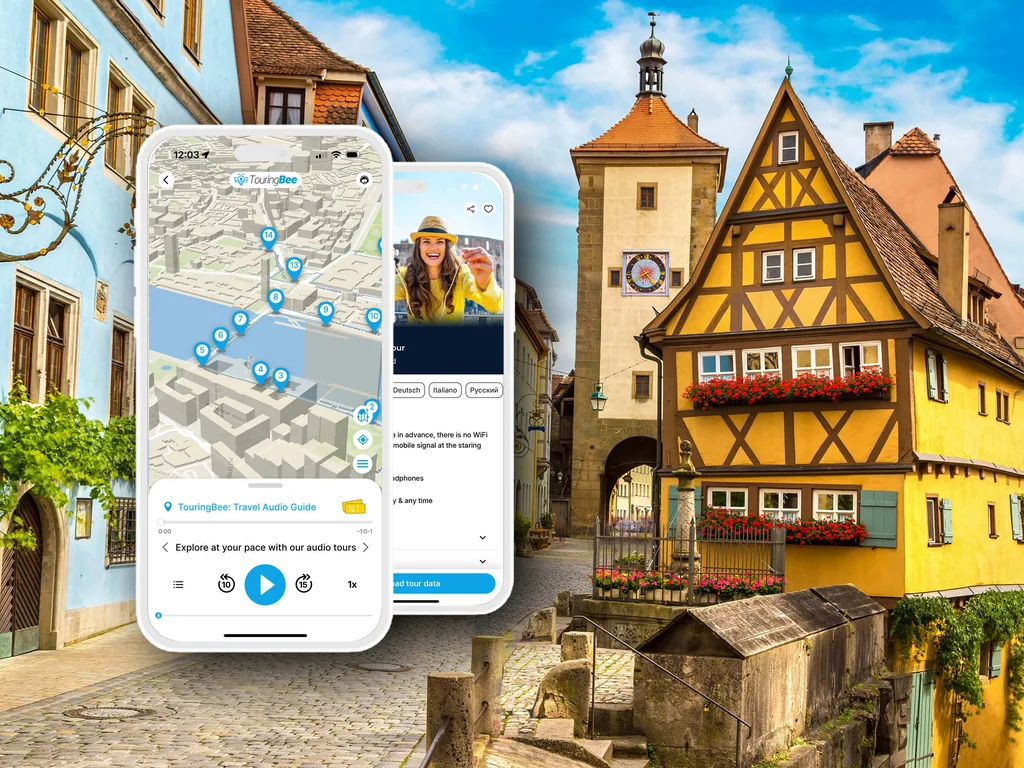
Rothenburg City Walk — Self-Guided Audio TourInstant access
- 100% offline — no Wi-Fi or data needed
- Offline GPS map — you start each track yourself at the spot
- 25 stops from Marktplatz to the Hospital Bastion
- Walk it in 1.5–2 hours, at your own pace
Practical notes
Fares and ticket conditions checked against Deutsche Bahn's own Bavaria portal in October 2026. Parking charges and the height limit are from the town's fee regulation, version of 31 July 2025. Journey times are from a rail guide last updated in 2025. Timetables and prices change — check your date before you travel.
Book the Bayern-Ticket for the group, not per person. Five adults travel for €74, two for €44 — and two adults with up to three children aged 6 to 14 also travel for €44, since those children are not counted. Write every traveller's name on it before you board; you cannot substitute someone later.
Look up the last train before you book anything else. It decides the shape of the day.
Build the branch line into your plan. Steinach to Rothenburg is hourly, so a missed connection at Steinach costs a full hour.
Don't count on left luggage at Rothenburg station. If you are passing through with bags, come by car, or ask at the restaurant where you eat whether they will hold them.
Cash. The Town Hall Tower takes cash only, and so do several smaller places.
Shoes. The whole old town is medieval cobble, and the wall walkway has uneven boards.
In short
By train it is about three hours each way, by car about 2h20. The Bayern-Ticket cuts the fare by roughly two thirds and, on weekdays, costs you the morning; an advance fare on the fast route buys the morning back. A tour coach hands you the 10:30–16:00 window and takes the decision away — see what is running on your dates — though that window closes before the December hour this page recommends.
None of that makes a day trip wrong. It makes it a trip you should plan backwards from the last connection, and ideally do in December or early January, when the hour worth seeing arrives before you have to leave.
Frequently Asked Questions
Can you do Rothenburg as a day trip from Munich?
Yes. It is about 2h30 to 3h30 each way by train and roughly 2h20 by car, which leaves three to seven hours in town, a little more if you drive early. It works better in winter, when the quiet hour falls before you need to leave, and on weekends, when the cheap ticket has no morning restriction.
How do you get from Munich to Rothenburg by train?
Every route changes at Steinach (b Rothenburg) onto a branch line that runs hourly and takes 15 minutes. From Munich you either take the fast route via Nürnberg and Ansbach, about 2h30 with three changes, or regional trains the whole way, about 3h30. Some RE80 services run through to Steinach, leaving you one change.
How much does the train from Munich to Rothenburg cost?
Roughly €50 each way on a flexible ticket, so about €100 for the return. A Bayern-Ticket costs €34 for the whole day and €74 for five adults, with up to three children aged 6 to 14 travelling free, but it is valid only on regional trains and, on weekdays, only from 09:00. Advance fares on the fast trains are usually cheaper than the flexible fare, though they are tied to the train you book.
Is the Bayern-Ticket worth it for Rothenburg?
For a group, clearly. For one person travelling on a weekday it cuts the fare by about two thirds but forces a 09:00 departure and the slower route, which means arriving around 12:30. On a Saturday or Sunday it is valid from midnight and the trade-off disappears.
How long does it take to drive from Munich to Rothenburg?
About 2h20, via the A9, A6 and A7. The town is 5 km off the A7, and the P1–P5 car parks outside the walls cost €1.30 an hour to a maximum of €8 a day.
How many hours do you need in Rothenburg?
Four hours covers the wall, the main square and one museum. Six to eight makes it a comfortable day, which is more than most day trips from Munich leave you — that is the trade. What matters more than the total is which hours they are: before 10:30 and after 16:00 are the quiet ones.
Is it better to stay overnight in Rothenburg?
Yes, if the choice is yours, because the early morning and the hour after the shops close are the two a day trip struggles to reach. In midwinter the evening gap nearly closes, because the lit hour starts at 16:20, on 11 December.
Continue exploring
Some outbound links on this site are affiliate links. If you book through them we may earn a commission, at no extra cost to you.
Three Hours Each Way — Make the Hours You Get Count
Twenty-five stops, about ninety minutes, written by historians and fully offline.
Get the Audio Guide — from €9.99